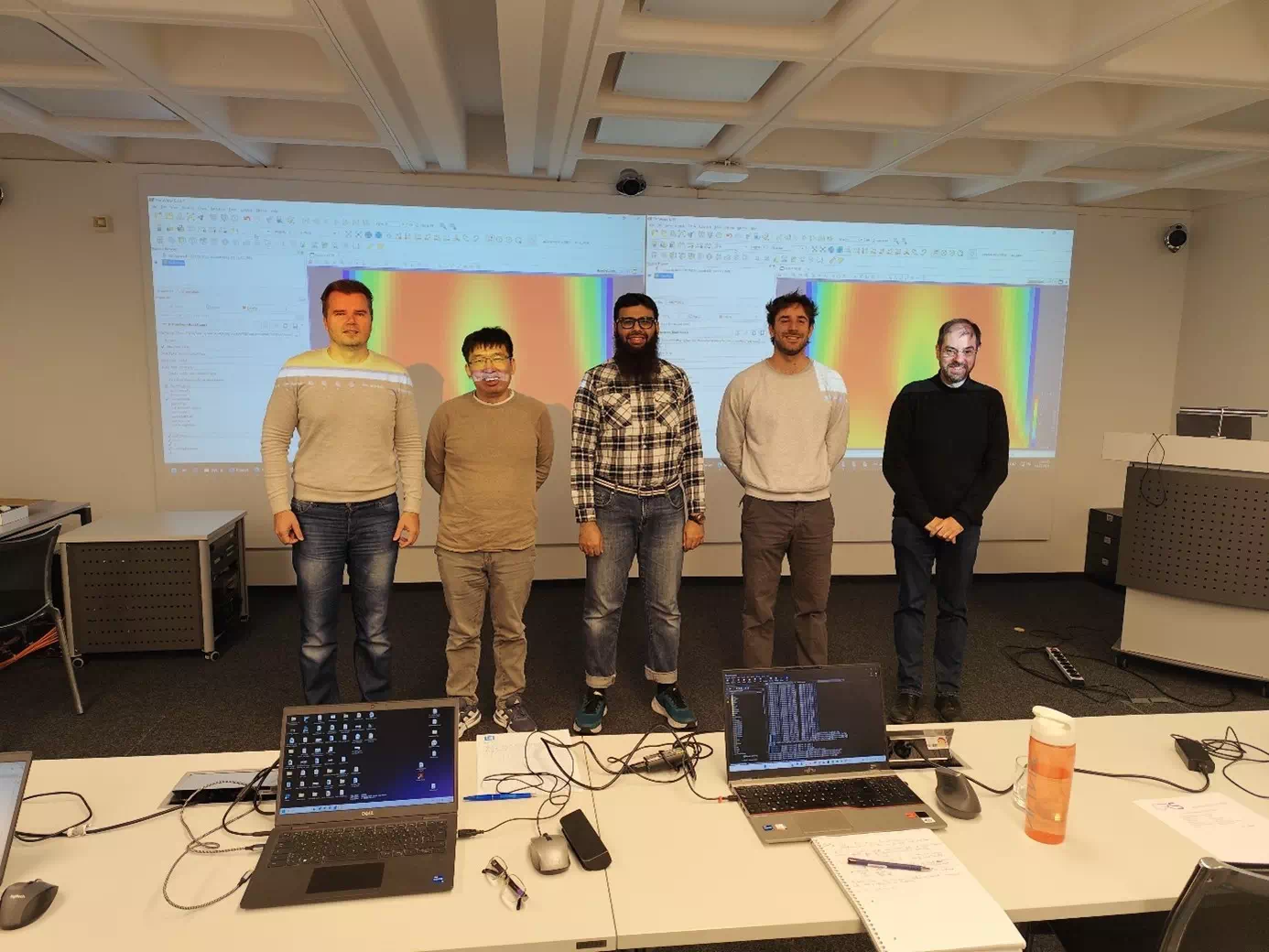
In October 2025, GO-VIKING partners gathered at GRS – Gesellschaft für Anlagen- und Reaktorsicherheit in Garching, Germany, for a two-day hands-on training dedicated to Fluid-Structure Interaction (FSI) with the coupled open-source program OpenFOAM-preCICE-CalculiX.
The training was delivered by the GRS expert Joachim Herb, who guided participants through both the theoretical foundations and practical implementation of state-of-the-art FSI tools.
Participants from GRS (Angel Papukchiev, and Zhi Yang), NRG PALLAS (Mohammed-Muaaz Hussain), and the von Karman Institute (VKI) (Enrico Pivato) took part in the workshop that aimed to strengthen the practical expertise on FSI tools across the consortium, and to support GO-VIKING’s ambition to advance accurate methods for analysing flow-induced vibrations in nuclear systems.
A deep dive into coupled FSI tools
The programme covered a complete workflow for FSI analysis, using some of the open-source tools applied within GO-VIKING, such as OpenFOAM, CalculiX, preCICE, and PrePoMax.
The workshop included the following sessions:
- Introduction to Fluid-Structure Interaction
- Overview of OpenFOAM, CalculiX, preCICE & PrePoMax
- Coupling OpenFOAM and CalculiX via preCICE
- FSI simulation of a simplified test case
- 2D Fluid-Structure Interaction simulation
- 3D simulation of the AMOVI experiment
- Post-processing and evaluation with ParaView, PrePoMax, and Jupyter Notebook
This combination of theory and practical simulation strengthened the partners’ ability to apply and validate advanced FSI methods - a key element in GO-VIKING’s mission to improve the reliability of flow-induced vibration predictions in nuclear power plant components.